
News · Tuvalu
TUVALU: Development Bank of Tuvalu - providing vital financial support
With a landmass of just 26 square kilometres, the nation of Tuvalu is one of the smallest and most remote countries on the planet.
Business Link Pacific’s partner in Tuvalu is the Development Bank of Tuvalu (DBT). We spoke to the CEO of the Development Bank of Tuvalu, Temukisa Pesega Siale about the bank’s vital role in Tuvalu and its partnership with BLP.
BLP is a private sector development programme funded by the New Zealand Government and works across 12 Pacific Island nations to stimulate demand for business advisory services and improve access to financial services.
The DBT was established in 1993 with a mandate centred on providing long-term financial assistance to the private sector to stimulate economic development.
“The banks focus is to support SMEs and the private sector offering loans tailored to different sectors in the economy like agriculture. In the outer islands we provide micro-loans to high-risk businesses. Around 80-90% of businesses in the outer islands are financially supported by the Bank, particularly those in retail and wholesale sectors,” says Temukisa.
The Tuvalu population of approximately 10,000 people live across eight islands, 50% in the outer islands and 50% in Funafuti, the capital and Tuvalu’s largest city. The Bank has 28 staff and seven branches spread across the country to service the population.
Working in the community
Small and Medium Enterprises (SMEs) in Tuvalu face a unique set of geographical and structural hurdles that make operating a business exceptionally challenging. While potential exists within the fisheries and tourism sectors, growth is often stifled by the nation's extreme isolation. Beyond the daily logistics, Temukisa notes that one of the most pressing issues for the sector is limited access to finance, driven largely by a lack of financial guidance and a need for improved financial literacy.
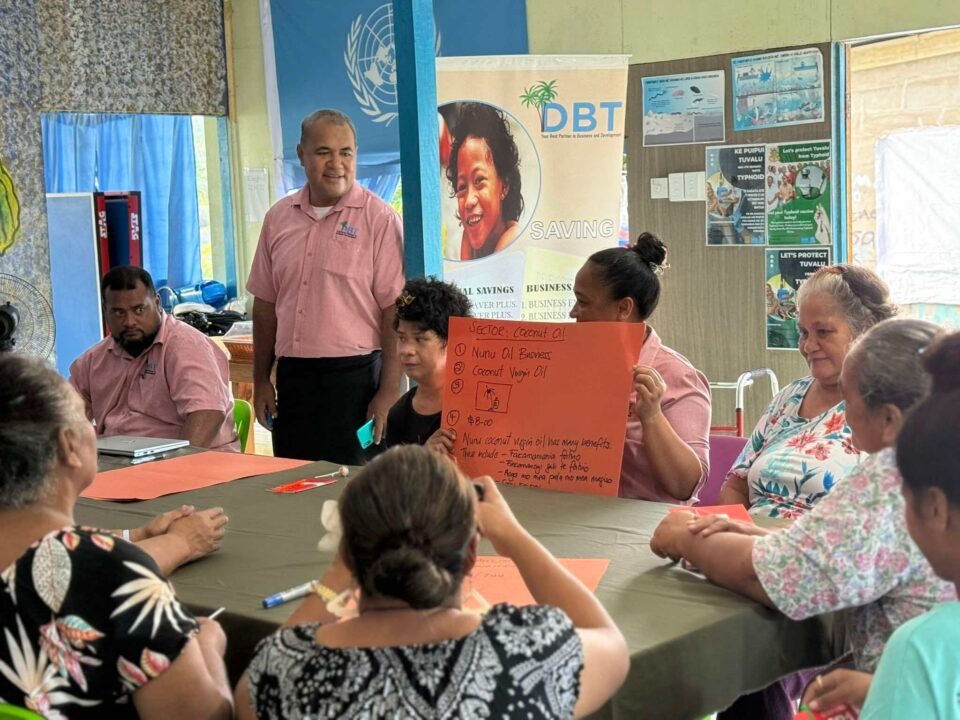
To lift the skills of the Micro, Small, and Medium-sized Enterprise (MSME) sector, the bank conducts targeted training with an emphasis on supporting businesses run by women, youth, and members of the Fusi Alofa Association (Tuvalu's association for people with disabilities). This support is vital given the country's demographic landscape; more than half of Tuvalu’s population lives in Funafuti, creating a concentrated but highly competitive environment for local entrepreneurs.
“Most MSMEs in Tuvalu are run by women on behalf of their families, often using manual bookkeeping systems,” says Temukisa. “That’s where Business Link Pacific (BLP) becomes vital. I know for small businesses to succeed, financial literacy is critical.” She adds that BLP’s diagnostic tools are essential for identifying the specific gaps that prevent these businesses from securing the loans they need to grow.
However, financial hurdles are compounded by broader environmental and economic pressures:
- Geographical Isolation & High Costs: As one of the most remote nations on earth, Tuvalu suffers from high operational costs and inconsistent shipping schedules. This impacts the fisheries sector, where getting fresh catch to international markets is difficult, and the tourism sector, which struggles with high travel costs and limited infrastructure.
- Climate Change & Environmental Vulnerability: Businesses navigate extreme environmental vulnerability, where rising sea levels and storm surges pose constant risks to physical infrastructure.
- Human Capital & "Brain Drain": The market size is further strained by a significant brain drain, as skilled workers frequently migrate to Australia and New Zealand.
Temukisa remains hopeful about the future of the workforce. “There is a brain drain with people migrating to Australia and New Zealand. Hopefully, these people will return after they have been overseas for a while, bringing new skills back to our community.”
DBT’s mandate includes not only economic development but also social development, says Temukisa. The Banks community support activities include trade fairs, sponsorships for small businesses, and small financial support for academic and sports community development.
Looking ahead, a new strategy plan is currently in development with a focus on digital transformation, financial inclusion, and climate finance, especially in the outer islands.
The goal of digital transformation is to improve general accessibility and efficiency outcomes for clients in the outer islands, moving towards a "bank in your pocket" model. The bank has an online platform but a new mobile application currently in development will give people more connectivity to bank services.
Expanding BLP services to MSMEs
The partnership with BLP is in its early stages, but Temukisa is excited for the opportunities ahead. The appointment of BLP Business Service Manager Tealofa Moses in late 2025 will help drive expansion of BLP services within Tuvalu.
Temukisa says, “The BLP partnership allows us to expand our range of services and connect more with the businesses here in Tuvalu. It also gives us greater financial standing as a development bank. Not just providing services from the bank itself, but a wider range of services to businesses.”
Since late 2024, the Bank has facilitated BLP financial support with BLP Small Grants to MSMEs. “These grants have been extremely positive and helpful to small businesses. It has been very popular as this sort of support is very rare in Tuvalu.”
Temukisa says expanding the use of BLP’s online self-assessment Business Toolkit will be of particular help to local businesses. “BLP’s diagnostic tools like the Business Health Check are extremely valuable in helping MSMEs to understand where they need to focus for improvement.”
BLP’s self-assessment online tools include the Business Health Check, Business Continuity Planner, Diagnostic Report (in conjunction with local Business Service Manager), Climate Action Sensor and Finance Finder.
The Climate Action Sensor for example, helps diagnose areas for improvement in a business and address vulnerabilities related to climate change, helping businesses plan for disasters and crises.
The bank also plans to engage with the BLP Advisory Network to connect MSMEs with expert business advisory services. Tuvalu businesses can access BLP advisors in other Pacific countries, but it aims to identify and bring local advisors into the BLP Network to provide on-the-ground support. To join BLP's quality-approved Network, business advisors are required to complete a thorough BLP Competency Assessment, which helps identify their strengths and areas for improvement.
Tuvalu’s unique geography and small population present distinct challenges for economic growth and business development. The partnership between the Development Bank of Tuvalu (DBT) and Business Link Pacific (BLP) plays a vital role in supporting the nation's private sector, especially micro, small, and medium enterprises (MSMEs).
Through targeted loans, financial literacy training, and innovation in digital tools, the DBT are expanding access to finance, fostering entrepreneurship, and building resilience in the face of climate and logistical challenges. As DBT continues to develop its strategy, the ongoing collaboration with BLP promises to further empower Tuvaluan businesses and communities, strengthening the country’s economic future.