
Case study · Tuvalu
Building local food security in Tuvalu
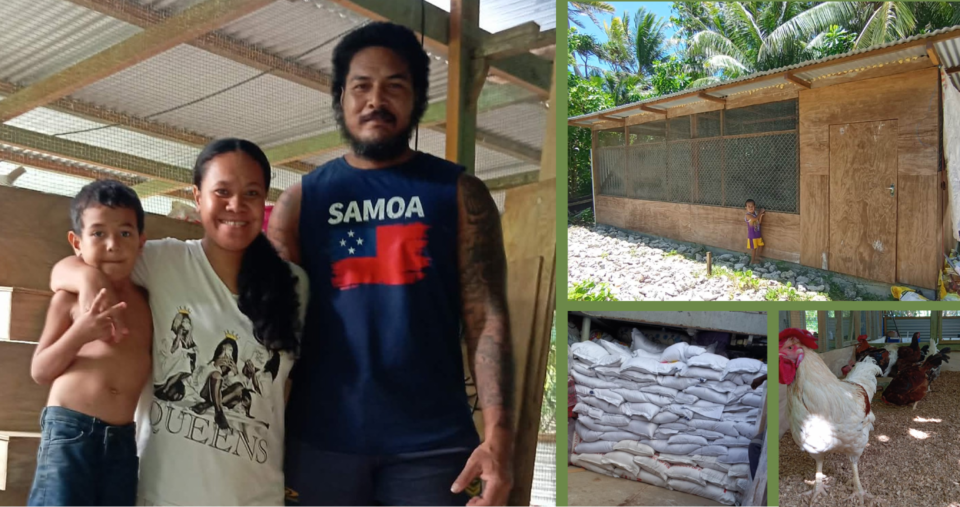
Supported by a BLP grant Hunter’s Poultry Farm was able to expand production, strengthen animal feed certainty, and support a more resilient local food supply.
Food security in Tuvalu is shaped by distance, climate, and cost. Much of the country’s food is imported, and fresh local production is difficult, with producers facing many obstacles.
Wanting to start a family business and determined to improve security in Tuvalu, Molu and Famelea Laupepa started Hunter’s Poultry Farm in 2023.
When shipments are delayed, the food supply tightens quickly. “When food is scarce, the price just goes up and up,” says Famelea Laupepa.
Building on family poultry experience and using land owned by Molu, their business focuses on egg production and incubated chicks to create a small farm with practical local impact.
With a $15,000 loan from the Tuvalu Development Bank, they purchased incubators with capacity for 1,000 eggs and Molu built their first chicken shed. Demand grew, but one challenge kept limiting production: reliable access to feed.
All poultry feed is imported, and ships arrive every three weeks, but shipments are not always dependable. Although the business bought in bulk whenever possible, cashflow constraints made it difficult to hold enough feed to manage delays.
Overcoming a growth barrier
In 2025, a $15,000 BLP grant helped the business remove the feed barrier to growth by allowing Hunter’s Poultry Farm to bulk purchase quality chicken feed. It also allowed the business to build safer feed storage and extend the chicken shed to house day-old chicks.
The results were immediate. For six to seven months after receiving the grant, the farm increased its capacity and sold all its eggs each day, reaching weekly sales of 17 trays of 30 eggs and more than 20 trays of a dozen eggs. Sales of chicks to the outer islands was also strong.
The business still faces pressure as loan repayments reduce the money available for feed, affecting production levels. But the grant has strengthened the farm’s foundation and shown what is possible when small businesses can invest ahead of supply disruptions.
The Tuvalu Government’s Department of Agriculture is supporting Molu and Famelea to build their technical knowledge. Hunter’s Poultry Farm has been selected as a model farm for capacity-building training, helping with knowledge like shed positioning, flock density, and automated watering systems.
Their commitment remains strong. “We know the challenges; we will not be giving up. We will keep going,” says Molu and Famelea.
Through Hunter’s Poultry Farm, Molu and Famelea are doing more than growing a business. They are helping demonstrate how local land, practical investment, and determination can strengthen food sustainability in Tuvalu.
BLP is a private sector development programme funded by the New Zealand Government. BLP works across 12 Pacific Island nations to stimulate demand for business advisory services and improve access to financial services.
To start your journey with BLP, you can self-assess your needs by using the free online tools available to help small- and medium-sized businesses diagnose areas in their businesses that an advisor could improve.
The first step can be the online Business Health Check. You can also check your business's resilience to respond to crises or climate change challenges on the Business Continuity Planner and the Climate Action Sensor. If you prefer to meet a local BLP representative in person to discuss your business, get in touch with our local partners to arrange a face-to-face Diagnostic.