
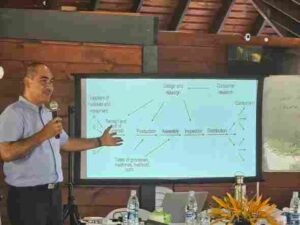
 We spoke to one of BLP’s quality approved advisors, Dion Paul from Quality Solutions about the wide-ranging benefits that accrue to businesses when they take the strategic step to get certified to international standards.
Dion’s business helps Pacific Island businesses achieve internationally recognised certification such as ISO, HACCP, Vegan and USDA NOP (National Organic Program)
“It’s good business, to stay in business,” says Dion.
“International standards and certification are well-known for their ability to support sales expansion in international markets, but it has other diverse and wide-ranging benefits. These benefits can be the difference between staying in business or not,” says Dion.
What standards & certification can unlock for businesses:
- Improved bottom-line & long-term business value
“It helps improve your day-today operational efficiency and often makes the work easier – this improved efficiency generally translate to higher margins, lower costs, better bottom-line results,” says Dion.
Certification improves a business’s reputation, and Dion says over time, this increases the value of businesses. This is of value if you are thinking of selling your businesses some time into the future.
- Access to international markets and a competitive edge
Quality certification provides businesses the opportunity to significantly expand sales to international countries. Overseas supermarkets and major commercial importers require suppliers from the Pacific islands, to hold at least HACCP certification.
It also gives local businesses access to multinationals in the Pacific. Certification provides a reassurance of quality and food safety for customers like major cruise ships, hotels, cafés, restaurants, resorts seeking quality food or other products. In doing so, businesses not only capture new customers but give themselves a competitive edge.
Dion says a good example of a successful outcome for a business supported by BLP and Quality Solutions is the Vanuatu food business Dynamic. It achieved the food certification standard HACCP in 2022 allowing them to export its Tahitian limes to New Zealand, including to large supermarkets such as Countdown.
In addition, it can directly supply the P & O cruise-ships visiting Port Vila. Orders in the past have been in the truck loads, for local fresh produce such as limes and pineapples and imported food product lines. Dynamic is the only retailer in Vanuatu with HACCP certification. Superyachts are also frequent clients, again, due to the credibility.
Not only is it a stepping stone to international market access but it helps a business secure both ‘preferred supplier’ status with clients providing a continuity of sales revenue and eligibility for certain tenders.
BildBeta, an engineering company in Port Vila, Vanuatu is pursuing certification to ISO 9001 as a strategic goal in 2026 through Quality Solutions to support its eligibility for overseas tenders. BildBeta was able a BLP 50% subsidy, improving the affordability of Quality Solutions services to support the start of its ISO journey.
- Business resilience in the face of adversity
To meet an International Standard, a business must assess all their business risks and build a plan to mitigate these risks.
“This is very helpful for Pacific businesses. If some crises or disaster happens, maybe, loss of power, fuel or flooding – whatever crises, there is an operational plan, ready to implement and mitigate the impact on the business.” He says it can be a game changer for the continuity of a business, ensuring continued critical sales revenue in times of adversity.
“One of our certified businesses in Vanuatu is the Vanuatu Abattoir Ltd (VAL – Pacific). When Covid lockdown came in, the domestic market basically died for them. They only survived as they could export. It was a lifesaver for them to be able to continue to export.”
- Providing business continuity when an owner is unavailable
Another benefit for owners, is that the process of defining and documenting all core operational processes to achieve a standard, gives a business more operational continuity and intellectual property (IP) which can be trademarked.
In many businesses, particularly smaller businesses, so much of the knowledge on how the business operates is locked inside the mind of the owner. If they are unavailable, maybe through illness or loss, this can halt a business.
So, with International Certification, we get everything out of the heads of the people in the business, and it is documented. This important organisational knowledge is then available to employees to keep the business going. This is a huge benefit to owners and employees in times of adversity.
About QSL
QSL helps Pacific Island businesses achieve internationally recognised certification such as ISO, HACCP and USDA NOP, helping them grow, access overseas markets, become leaders in their industries, and be eligible for international tenders.
Dion leads a team of certification consultants working in Vanuatu, Tonga, Fiji, Samoa and Solomon Islands, across a range of sectors including public transport, food safety, organics, manufacturing, primary industry export and occupational health & safety.
Quality Solutions itself, as a consulting business, is ISO 9001 certified.
As a BLP approved advisor, Dion can apply on behalf of his clients for up to a 50% BLP Advisor subsidy, which makes his advisory support more financially accessible to Pacific SMEs.
https://qualitysolutionspacific.com/
How does international standards and certification work?
When a business is internationally certified to a ‘standard’, it means that their business has operations/products/services that meet and been audited by a third-party accredited Conformity Assessment Body (CAB) to a certain recognised international quality standard. Quality Solutions only prepares SMEs for the CAB audits but does not perform them themselves.
Certification gives customers confidence that the products or services they buy, will be to an internationally agreed quality or safety standard.
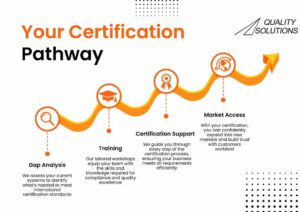 Quality Solutions works with businesses, helping them implement the right operational processes and helps them generate process documentation to meet the International Standard they are seeking. This involves technical writing, process mapping, staff training and then internal audits of these systems.
Dion says sometimes putting in place the right operational processes means businesses may need to invest in some different equipment. “This can be a barrier to some businesses purely from a financial standpoint, but for those where the business can finance these changes, it is a significant strategic step towards sales expansion, and bottom-line improvement.”
In the Pacific, businesses mostly seek the following international standards businesses:
Codex HACCP – a global food standard
ISO 9001 – Quality Management Systems for both service providers & manufacturers
ISO 22716 – Good Manufacturing Practices – Cosmetics e.g. soaps, lotions etc…
Not just a piece of paper on the wall
“Once achieved these standards are not just a piece of paper on the wall,” says Dion. “The changes made to achieve the standard, lead to ongoing benefits for the business.”
For Pacific SMEs, international standards certification is more than a passport to export markets—it is a practical way to strengthen the day-to-day foundations of the business.
By tightening processes, documenting how work is done, and planning for risk, certification can lift efficiency and profitability, build long-term reputation and value, and help ensure continuity when shocks hit or key people are unavailable. – Resilience.
As Dion Palu notes, “it’s good business, to stay in business”—and certifications and standards provide a clear, credible pathway for Pacific businesses to grow, compete, and keep delivering, even in adversity.
To book an appointment with Quality Solutions, click on this booking link: Booking link: https://calendly.com/qsl_vanuatu
Transform your business with quality advice. To start your journey with BLP, you can self-assess your needs by using the free online tools available to help small- and medium-sized businesses diagnose areas in their businesses that an advisor could improve.
The first step can be the online Business Health Check. You can also check your business’s resilience to respond to crises or climate change challenges on the Business Continuity Planner and the Climate Action Sensor. If you prefer to meet a local BLP representative in person to discuss your business, get in touch with our local partners to arrange a face-to-face Diagnostic.