
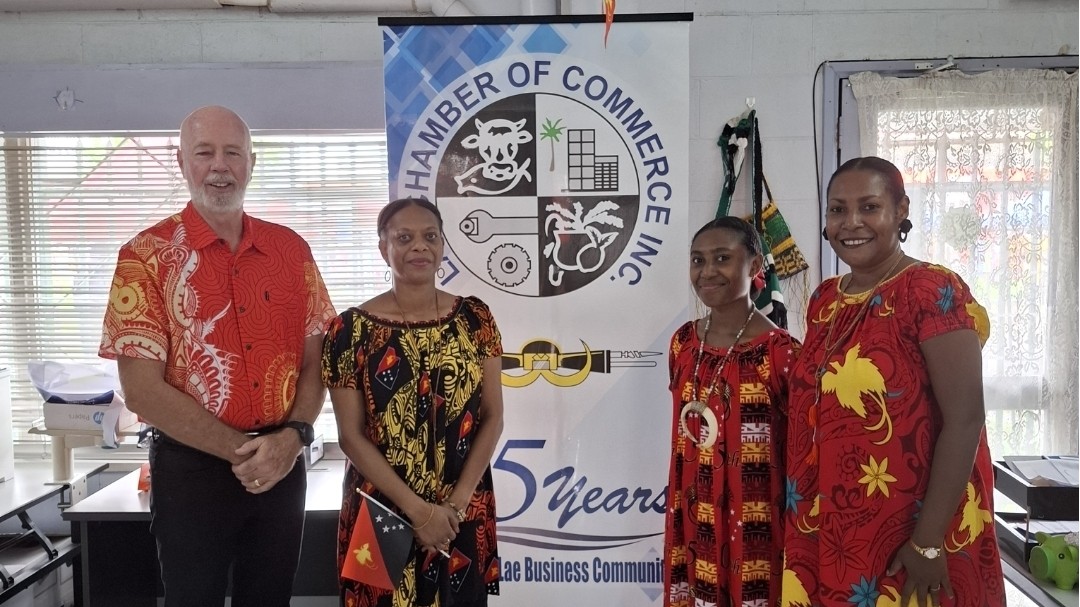
One of BLP’s partners in PNG is the Lae Chamber of Commerce Inc (LCCI). We spoke to Chamber President John Byrne about how they promote the interests of their members and the wider private sector.
LCCI is a small team led by our Executive Officer, Jenna Rekon and supported by Ensie Rennie and Tina-Maree Ulam and has been a Chamber of renown for over 67 years.
“I believe our strong partnerships and stakeholder relationships are at the core of the Chamber’s success”, John says “but our success is determined by strong businesses, and quality start-ups, aligned with good governmental relationships
“We are held with regard for our considered view. The strength of our relationships helps us succeed in community and business outcomes.” With over eight years at the helm of the LCCI, John should know, though as he says, “I am the current custodian of this position, many have been before and many will follow, others judge our results and the merit of being a member”.
In particular, he recognises the strong relationship the LCCI has with the Lae City Authority.
“They empower our business. The Chairman is our Lae Open Member and Deputy Prime Minister who is a strong leader espousing and enacting same values and approach to driving Lae’s development. LCCI is seen as a partner to the Authority and vice-versa. This is very important with tangible and visible improvements every month”
As the capital of the Morobe Province, Lae is the gateway to the population dense Highland Provinces and is the second largest City in Papua New Guinea.
“Lae is the engine room of the country,” says John. The city boasts of a wide range of businesses and a vibrant commercial sector involved in importing, re-packaging, manufacturing, transportation and exporting goods – 60% of the volume of goods in and out of PNG, go through the Lae Port, both domestically and internationally.
The LCCI plays an important role in representing its membership and partnering with bodies to support the path to private sector development. John says the big-ticket projects to accelerate private sector growth in Lae are improvements in infrastructure and more reliable data and power.
The LCCI has 13 councillors, nine men and four women which are responsible for different portfolios and a stable chamber membership of 240 businesses. Its members include SMEs and corporates ranging through agri-business, manufacturing, shipping, transport, fisheries, retail and wholesale sectors.
In recent times, John says the development of chamber communications has been a service which has supported stakeholder connectivity. “The one we get compliments on all the time is our communication, like our WhatsApp groups.”
When discussing the future of the LCCI, John says the encouragement of youth in the Chamber is critical. “Five years ago, we started the fire to get more young people into the chamber. Now we have a couple of young local business men and women who have formed the Young Lae Chamber of Commerce. We work in tandem and need the voice of young people coming through as they are the future leadership. That excites me, seeing youth join. Any organisation needs the energy and enthusiasm of youth, coupled with the energy of experience”
With coffee and cocoa industry being two of the dominant crops in the region and the high prices international, John says there has been a lot of cash around in the market and even more reason for the Chamber to help micro businesses learn how to grow their business.
“This is why BLP is important, if we can help to get our people to learn how to turn go from a ‘get it and spend it’ mentality to a ‘save it and grow a business’ mentality. It’s a better cycle.”
LCCI delivers the New Zealand government funded BLP programme in Lae and the wider region to support sustainable business development and says the Chamber has a strong and open relationship with Australian and New Zealand governments.
“I love the BLP model. It is the smartest and best models because of its sustainability market focus, from what I could describe as donor organisations. One day BLP may not be there, so it works on a circular programme model to build a sustainable market for the long term.”
He says LCCI, through Ensie Rennie (BLP Business Service Manager), connects members and the wider MSME community to the BLP online tools, Business Diagnostic support, financial support and a network of BLP approved business advisors.
As proof of how much he likes the BLP programme, John is also an BLP Approved Advisor of the business he runs with his wife Julliane Terry – Tok Stret Consulting Limited.
BLP are grateful for the partnership with the LCCI and its commitment to MSME development. Experience matters and, in this case, the LCCI have plenty to offer towards advancing initiatives for its members and the wider private sector.
To start your journey with BLP, you can self-assess your needs by using the free online tools available to help small- and medium-sized businesses diagnose areas in their businesses that an advisor could improve.
The first step can be the online Business Health Check. You can also check your business’s resilience to respond to crises or climate change challenges on the Business Continuity Planner and the Climate Action Sensor.
If you prefer to meet a local BLP representative in person to discuss your business, get in touch with BLP local partners to arrange a face-to-face Diagnostic